
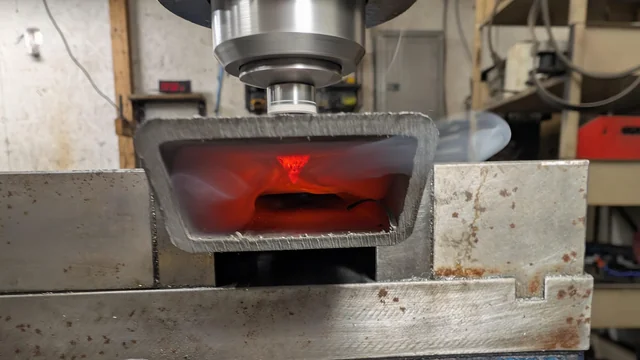
First off, thank you to everyone who’s been following along with our progress. The interest and support mean a lot to us, and we’re excited to share more about how we’re building this platform from the ground up. Today, we’re taking you behind the scenes into how we engineer the 3R Simworks rig using friction drilling, forming taps, and real‑world testing to build a durable, modular steel sim rig.
Friction Drilling: Creating Structural Mounting Points
One of the core techniques we use is friction drilling, a process that lets us create strong, extruded holes directly in steel tubing without adding inserts or welded nuts.
Using a tungsten carbide bit, we generate enough localized heat to soften the steel and form it downward into a clean, elongated extrusion. This creates additional material thickness around the hole — perfect for threading.
From there, we tap the hole and it becomes a fully integrated mounting point.
These friction‑drilled and tapped holes are where all expansion components attach, including:
- shifters
- handbrakes
- aluminum profile accessories
- and eventually, motion platform components
Because the threaded material is part of the steel itself, the result is incredibly strong and reliable — exactly what we want for a modular rig that’s built to evolve.
Forming Taps: Threads That Are Part of the Frame
After friction drilling, we use a forming tap to create the threads. Unlike a cutting tap, a forming tap doesn’t remove material. Instead, it roll‑forms the steel into shape.
This gives us:
- harder, stronger threads
- no chips or debris
- a fully integrated threaded structure
- maximum durability over the life of the rig
These aren’t add‑ons. They’re not inserts. They’re not welded nuts.
They’re structural threads formed directly into the steel frame — and they’re a big part of what makes our platform so robust.
Prototype Testing: Rigidity, Comfort, and Real‑World Loads
We’ve been testing prototypes for quite a while now, pushing the platform through:
- rigidity tests
- load and stress evaluations
- comfort and ergonomics checks
- functional testing with real hardware
The results have been incredibly positive. Every iteration brings us closer to the final production‑ready design, and we’re thrilled with how the platform is performing.
Closing in on a Release Candidate
If things have seemed quiet at times, it’s only because we’ve been working on this with every spare minute we have. We’re now very close to having a prototype that’s ready for production.
A full unveiling post is coming soon — and we can’t wait to show you what we’ve built.
More updates on how we engineer the 3R Simworks rig will be rolling out as we finalize the last pieces.
— The 3R Simworks Team
Join the discussion on our Reddit page:
If you want to see the full discussion around friction drilling, the Reddit thread is here:
https://www.reddit.com/r/3rsimworks/comments/1otq9qt/building_the_rig_part_1_friction_and_flow/
Main Community Links:
Reddit: https://reddit.com/r/3rsimworks
Instagram: https://instagram.com/3RSimworks